AAT sets no formal entry requirements for the Level 2 Certificate in Accounting, which means the first decision is yours rather than theirs: start at Level 2, or register straight at Level 3. The honest answer is in the guided learning hours and in one unit that carries 30 per cent of the Level 2 grade while quietly examining the other three again.
Start at Level 2, or skip to Level 3?
Nothing stops you registering at Level 3. AAT's own position is that students can start with any qualification depending on existing skills and experience, and it recommends beginning with a good standard of English and maths. For anyone unsure, AAT Skillcheck is the intended tool — a short online test that points you at the level your current knowledge fits.
The structural difference between the two is easy to underestimate. Both are four-unit qualifications, but the Level 2 Certificate carries 255 guided learning hours against 400 for the Level 3 Diploma. Per unit, that is roughly 64 hours at Level 2 and 100 at Level 3 — a Level 3 unit is more than half as long again as a Level 2 one, taught at a faster pace and assuming double entry is already second nature.
| Level 2 Certificate in Accounting | Level 3 Diploma in Accounting | |
|---|---|---|
| Qualification number | 603/6338/1 | 603/6337/X |
| Units | Four, one assessed synoptically | Four, no synoptic |
| Guided learning hours | 255 | 400 |
| Guided learning per unit | about 64 | 100 |
| AAT registration fee | £187 | £244 |
Qualification numbers and guided learning hours come from AAT's qualification specifications; fees from AAT's fees pages. The per-unit row is arithmetic on those hours.
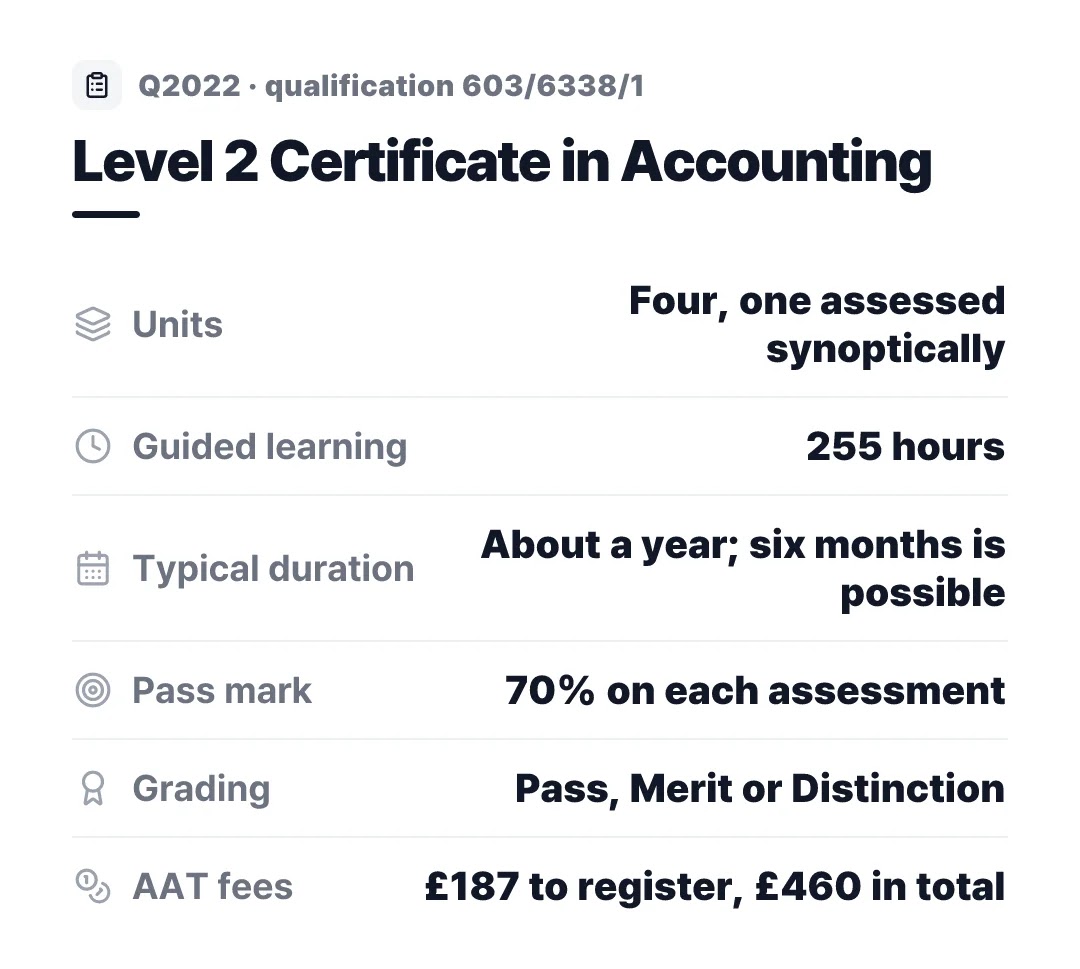
Timing is the other input. AAT puts the Level 2 Certificate at around one year, though it notes completion in as little as six months is possible. Costs sit alongside that: £187 to register, then £67 for each of the three unit assessments and £72 for the synoptic, so £460 to AAT before any tuition. Training provider fees are separate and, on AAT's own figures for this qualification, run from £600 to £2,000.
The synoptic is 30 per cent, and it revisits the other three units
The four units are not equally weighted, and the largest share belongs to the one most people treat as an afterthought.
| Unit | Share of the qualification | How it is assessed |
|---|---|---|
| Introduction to Bookkeeping | 25% | Standalone assessment |
| Principles of Bookkeeping Controls | 25% | Standalone assessment |
| Principles of Costing | 20% | Standalone assessment |
| The Business Environment | 30% | Synoptic, drawing on the other units |
Weightings are AAT's own for the Level 2 Certificate in Accounting.
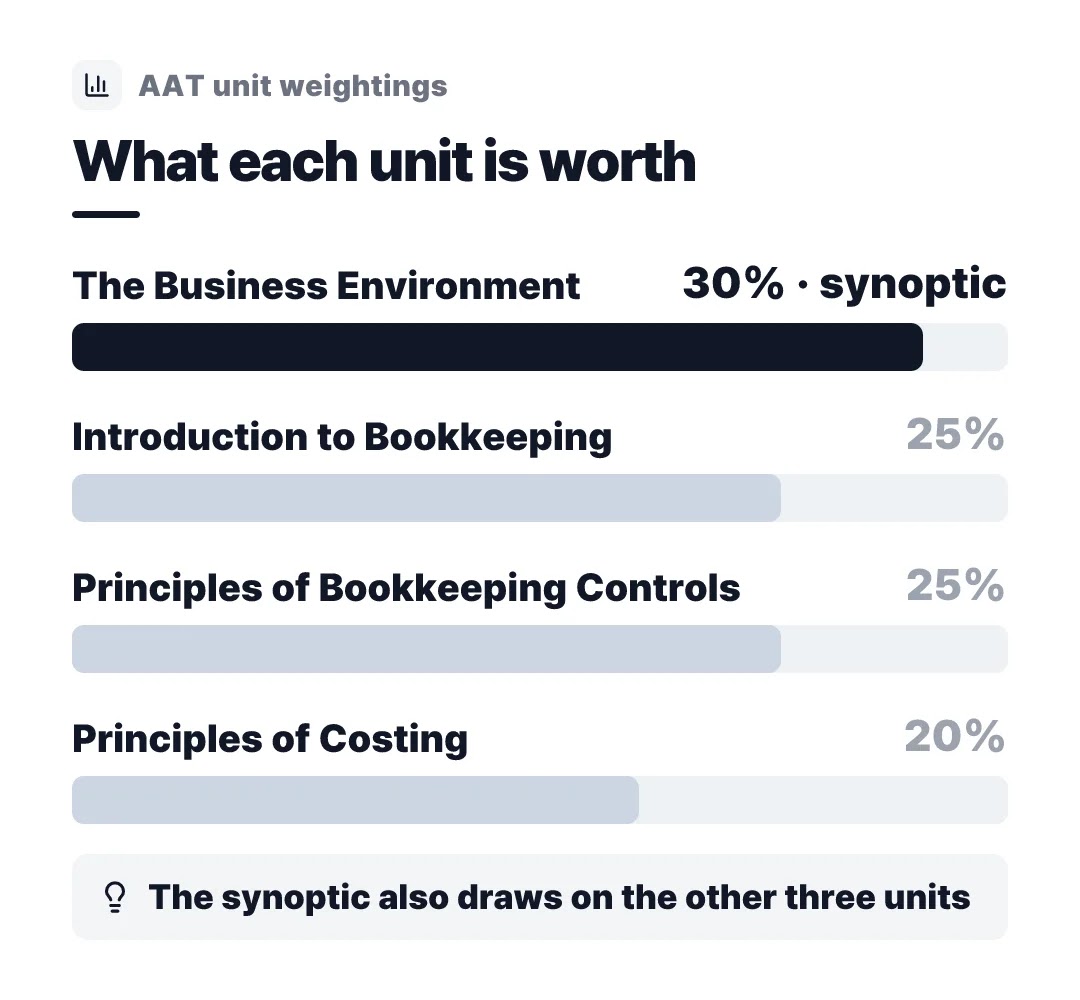
Read the right-hand column and the arithmetic changes. Bookkeeping and costing are worth 70 per cent through their own assessments, then appear again inside a synoptic worth another 30. A weak grasp of control accounts does not cost you once; it costs you in Principles of Bookkeeping Controls and again in The Business Environment. That is the argument for treating the synoptic as a revision exercise across the whole certificate rather than as a fifth topic to learn at the end.
Each assessment is computer-based with a 70 per cent pass mark, and the qualification is graded Pass, Merit or Distinction from the weighted marks. Sequencing follows from the weights: bookkeeping first because everything leans on it, costing next because it stands apart, and the synoptic last, once there is something to synthesise.
What happens at Level 4 if you start now
Anyone beginning Level 2 today will meet a Level 4 that does not yet exist in its current form. AAT is withdrawing the Q2022 Level 4 Diploma in Professional Accounting: new student registration closes on 31 August 2026, with a final assessment deadline of 31 July 2028. In its place, the Level 4 Diploma for Professional Accounting Technicians is available for first teaching from 1 September 2026, with five mandatory units and 400 guided learning hours.
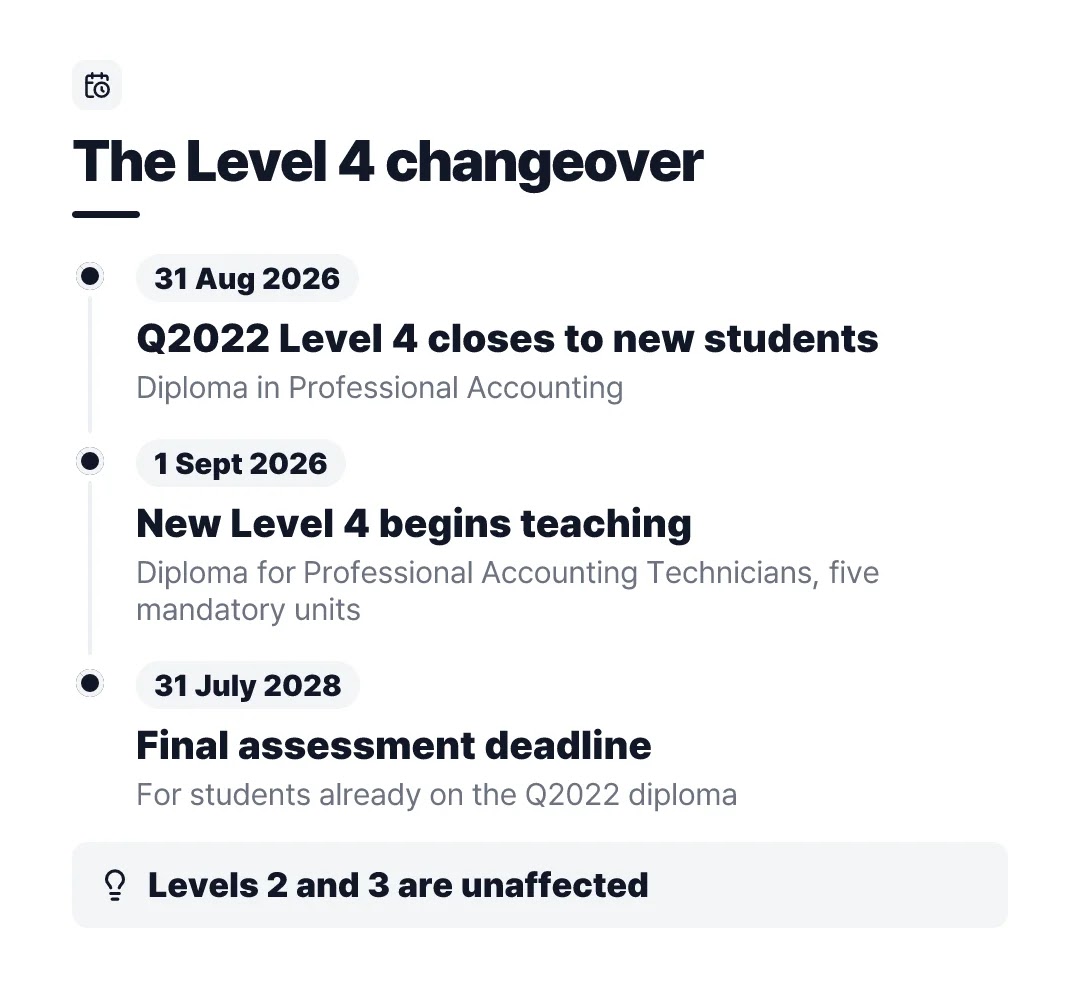
Levels 2 and 3 are unaffected, so this is not a reason to rush or delay. It is a reason to check which Level 4 you are enrolling on when you get there, and to be careful with second-hand study material at that stage — the optional-unit structure of the outgoing diploma does not carry across to the five mandatory units of the new one.
What is in the 30 pages
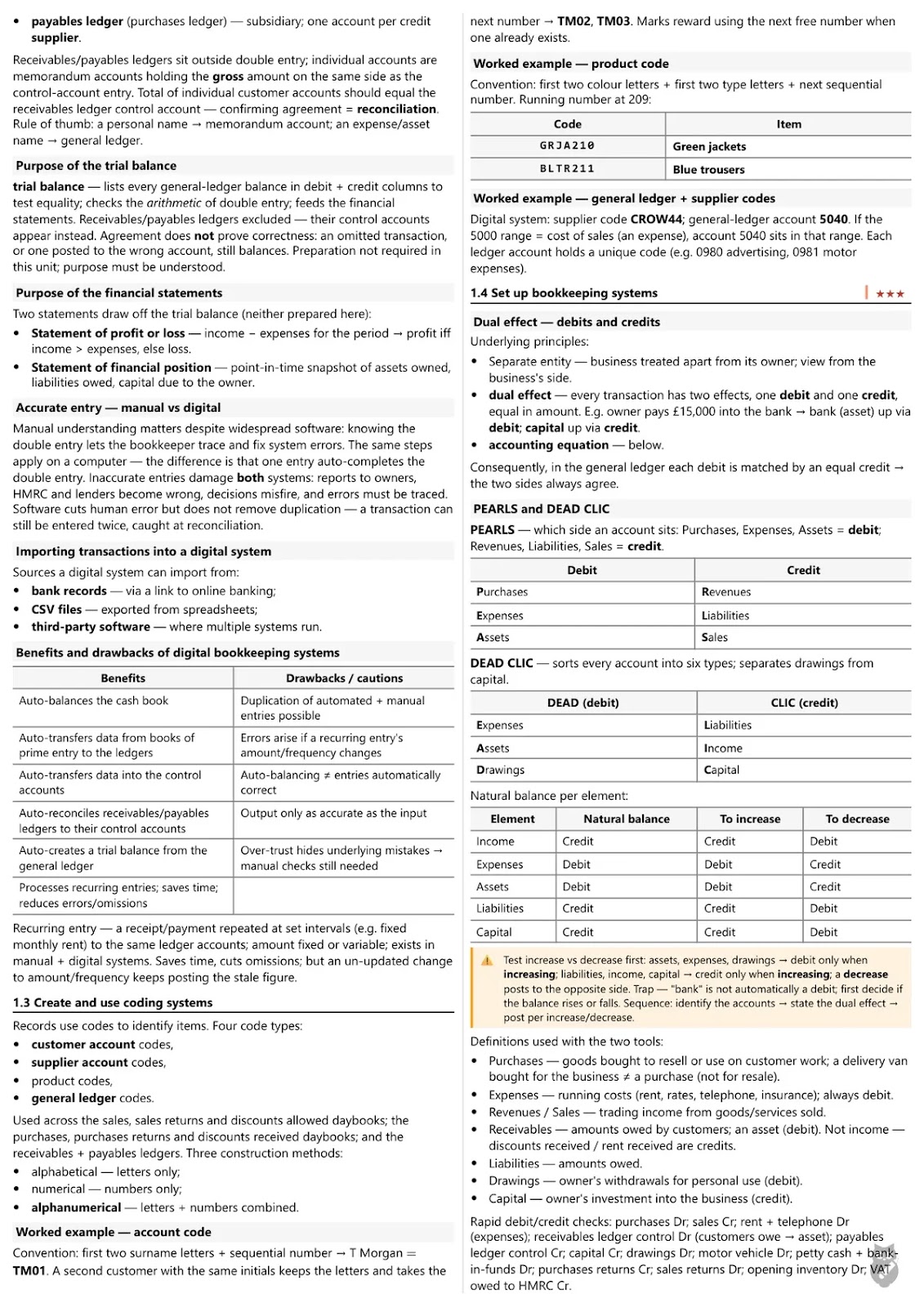
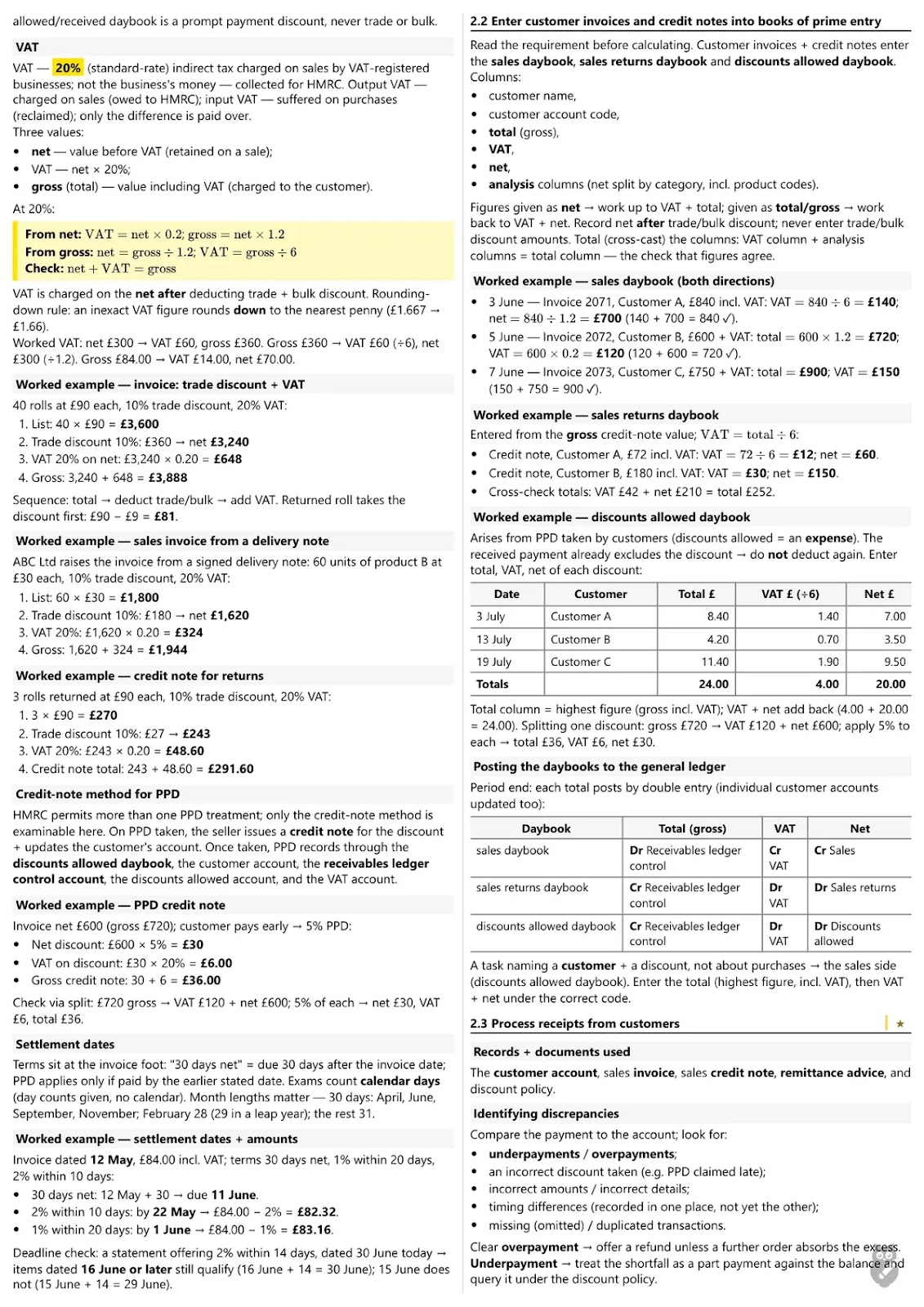
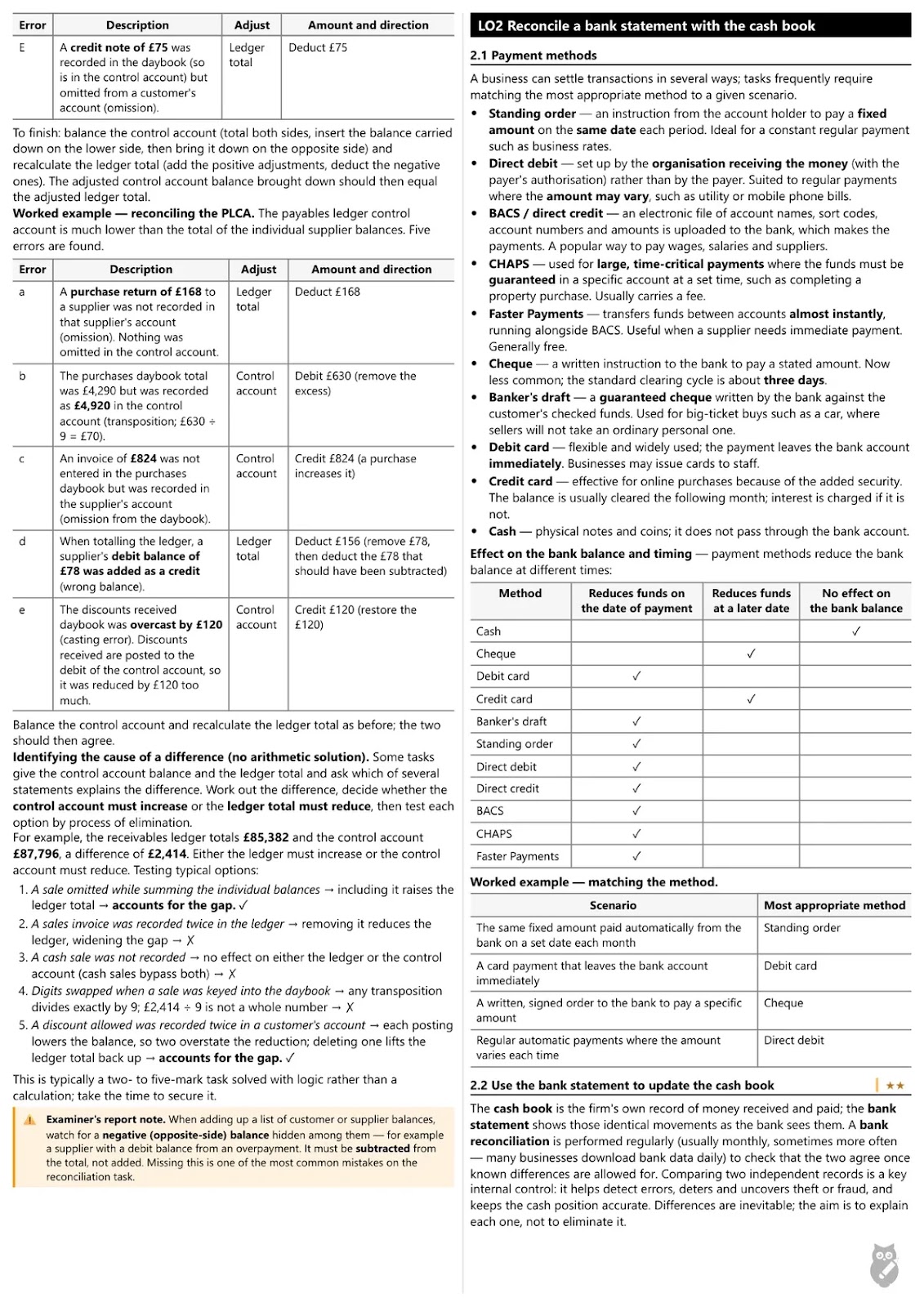
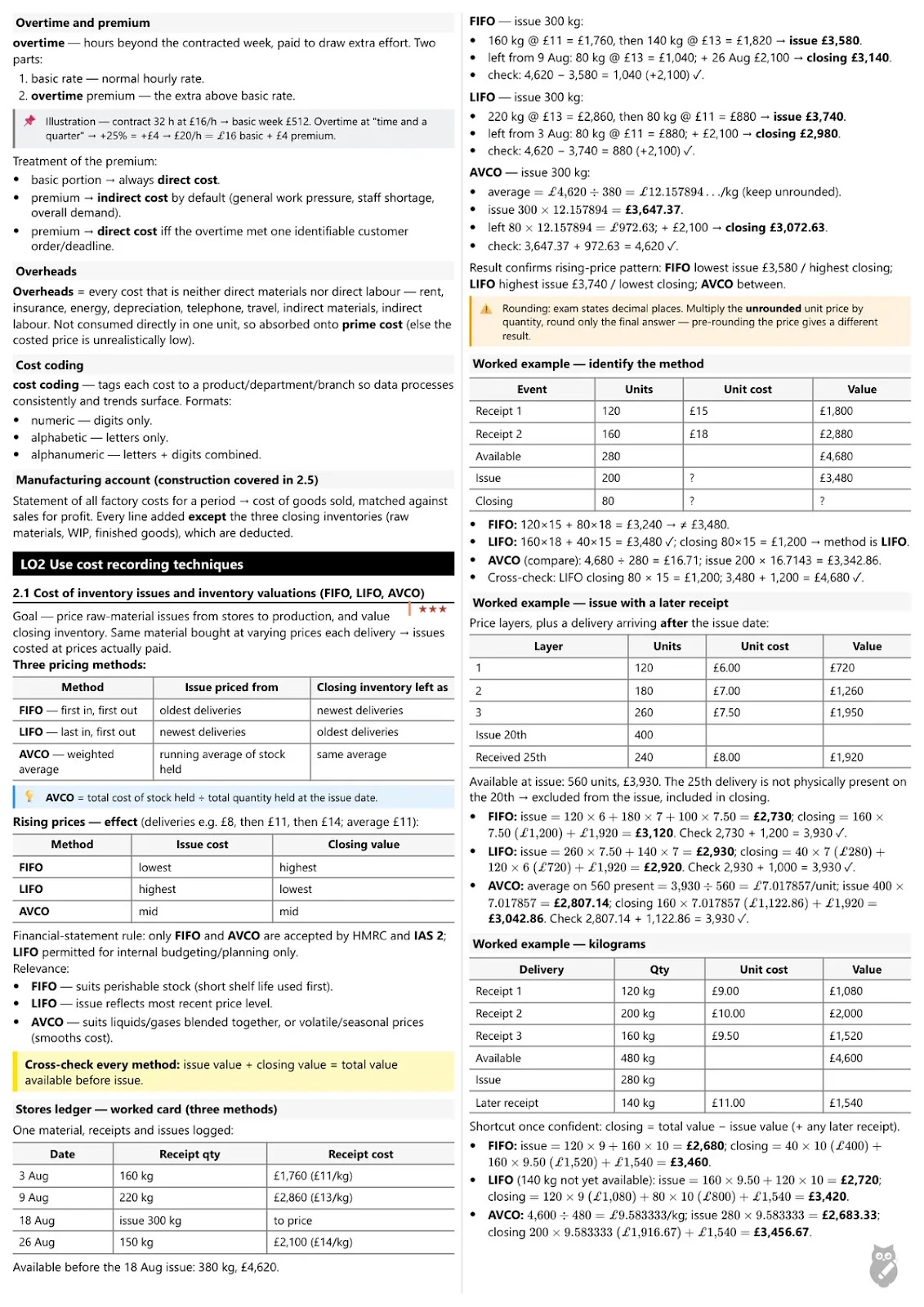
Swotnote's AAT Level 2 revision notes run to 30 pages, weighted towards tested topics rather than reproducing the specification in order. Control accounts, double entry and costing take the space; areas that are lightly assessed are covered lightly, which is the trade-off that keeps the notes to 30 pages.
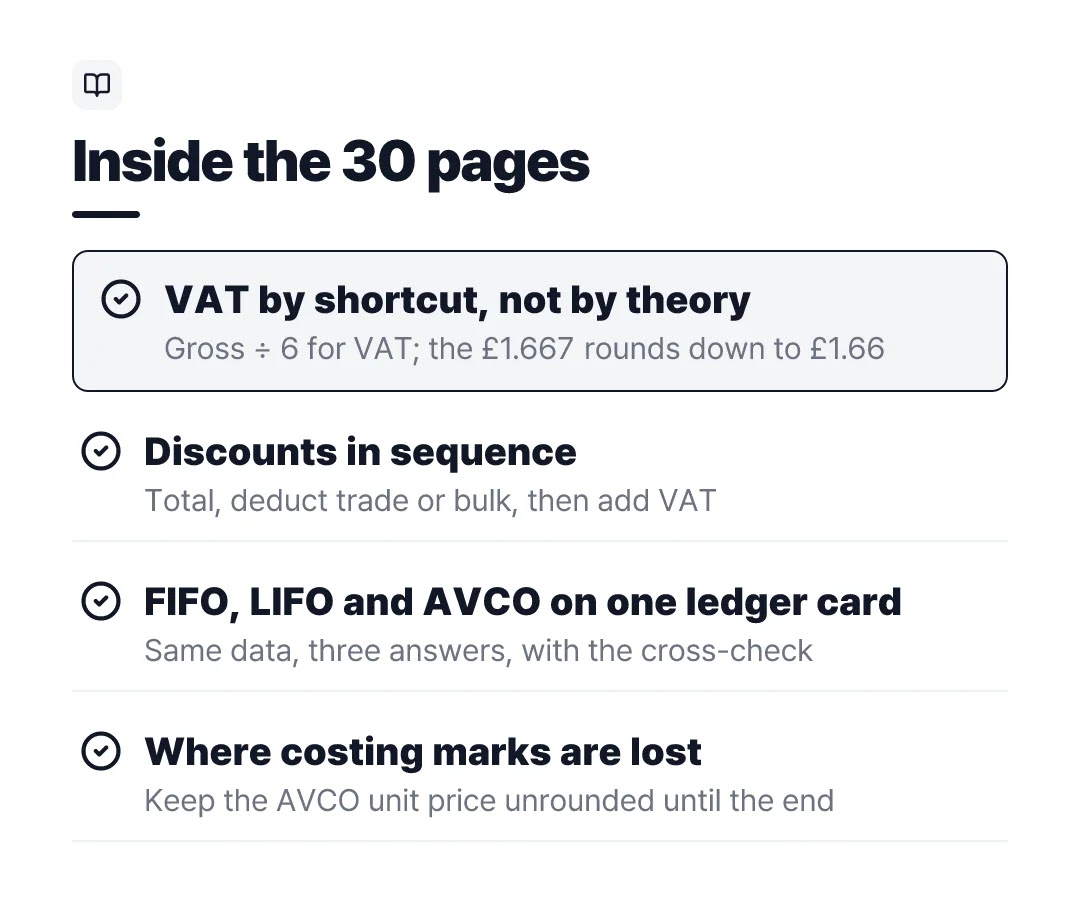
The material is written around the calculations that actually appear. VAT is handled with the shortcuts rather than the theory: net times 1.2 for gross, gross divided by six for the VAT, and the rounding-down rule that turns £1.667 into £1.66. Trade discount, bulk discount and prompt payment discount are put in sequence — total, deduct trade or bulk, then add VAT — with worked invoices and credit notes at each step, including the credit-note method for PPD, which is the only treatment examinable here.
Costing follows the same approach. FIFO, LIFO and AVCO are set against one stores ledger card so the three answers can be compared on identical data, with the cross-check that issue value plus closing value must equal the total available. The rising-price pattern is stated as a rule — FIFO lowest issue and highest closing, LIFO the reverse — alongside the point that only FIFO and AVCO are accepted under IAS 2 and by HMRC. Overtime premium gets its direct-or-indirect test, and the AVCO worked examples keep the unit price unrounded until the final answer, which is where most marks in that task are lost.
👉 AAT Level 2 revision notes — PDF (30 pages)
https://www.swotnote.com/library/aat-level-2-revision-notes
Questions before you register
Can I start at Level 3 without doing Level 2?
Yes. AAT does not require Level 2 first, and students with bookkeeping experience often begin at Level 3. Use AAT Skillcheck before deciding, and be realistic about double entry: Level 3 assumes it rather than teaching it.
How long does Level 2 take?
AAT puts it at around a year, with six months possible for students studying intensively. The qualification carries 255 guided learning hours, so the honest planning figure is your own weekly study time divided into that.
Is The Business Environment really a separate subject?
Partly. It has its own content, but it is assessed synoptically and draws on the other three units, and it carries the largest single weighting at 30 per cent. Treat it as the point where the certificate is pulled together rather than as an isolated final unit.
Where to begin
Level 2 is four units and 255 guided learning hours, with a 70 per cent pass mark on each assessment and an overall grade weighted across them. The Business Environment synoptic carries 30 per cent and re-examines bookkeeping and costing, so those two units decide most of the grade twice over. Registration and assessment fees come to £460 before tuition.
Run AAT Skillcheck first, and if it puts you at Level 2, book Introduction to Bookkeeping before anything else — the rest of the certificate is built on it.
📄 30 pages against the Q2022 Level 2 specification
https://www.swotnote.com/library/aat-level-2-revision-notes
Swotnote publishes independent revision material and is not affiliated with AAT or with any other awarding body. These notes are not official AAT study material and are not accountancy or tax advice.