The hazard perception clip that passes a car driver will fail you on the lorry and bus test. The car pass mark is 44 out of 75; the LGV and PCV pass mark is 67 out of 100. Same five-point scale, same clip format — a materially higher bar. That gap, and the 85 out of 100 needed on the multiple-choice part, are the two numbers a revision plan for Driver CPC part 1 has to be built around.
What Driver CPC part 1 actually consists of
Part 1 is the theory stage of the initial Driver CPC qualification, and it splits into two separately booked tests. Part 1a is the multiple-choice paper: 100 questions in 1 hour 55 minutes, with a pass mark of 85 out of 100. Part 1b is hazard perception: 19 video clips containing 20 scorable developing hazards, scored up to 5 points each, with a pass mark of 67 out of 100.
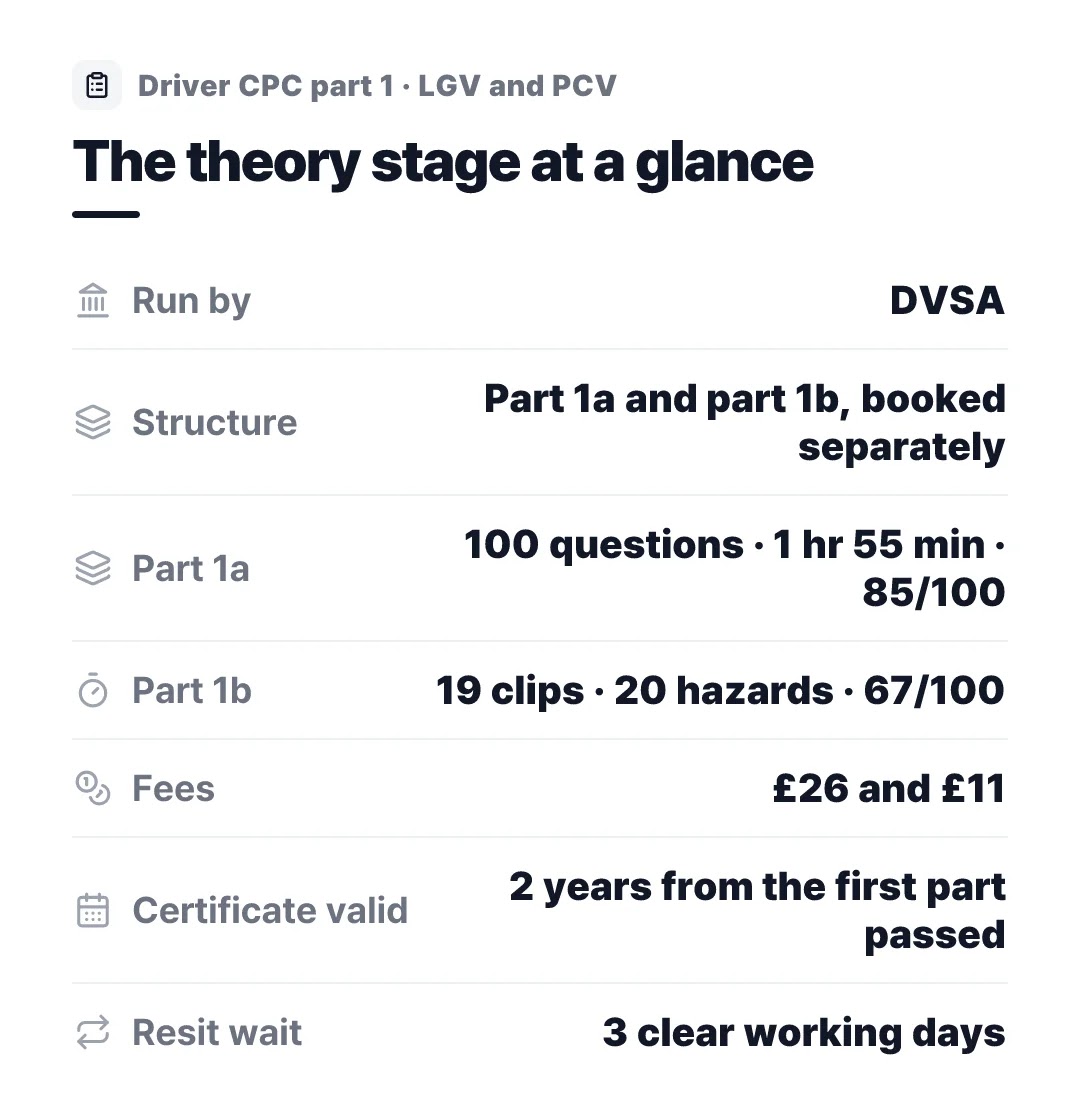
You book the two parts separately, though you can sit them on the same day. Results are handed over at the test centre, and a fail letter identifies the weak topic areas. Both passes together produce the theory test certificate you need before booking the part 3a and part 3b driving tests.
The two pass marks, next to the car test
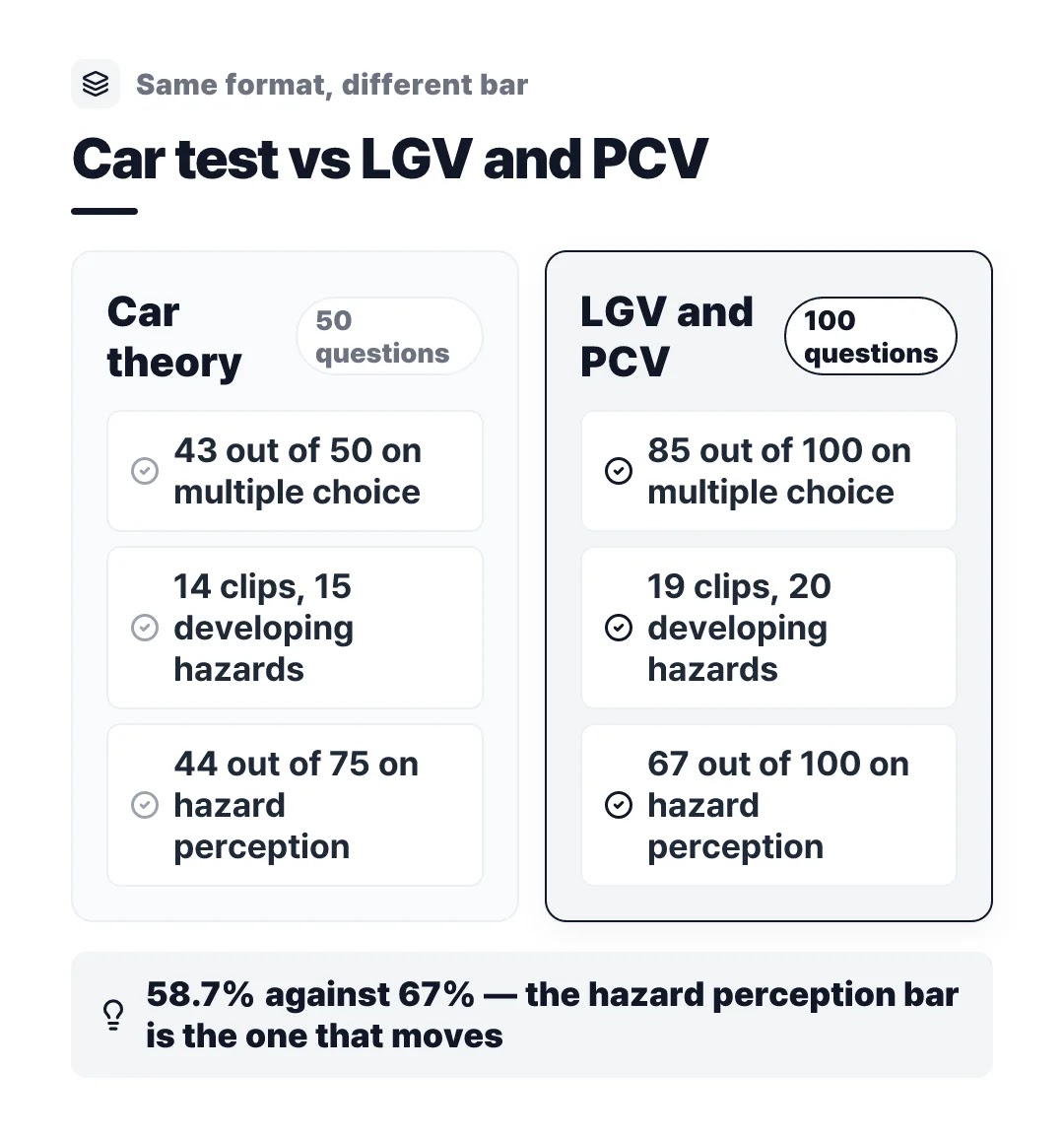
Most candidates arrive having passed a car theory test at some point, and assume this is the same exercise scaled up. The figures say otherwise, particularly on hazard perception.
| Car theory test | Driver CPC part 1 (LGV/PCV) | |
|---|---|---|
| Multiple-choice questions | 50 | 100 |
| Time allowed | 57 minutes | 1 hour 55 minutes |
| Multiple-choice pass mark | 43/50 (86%) | 85/100 (85%) |
| Hazard perception clips | 14 | 19 |
| Scorable developing hazards | 15 | 20 |
| Hazard perception pass mark | 44/75 (58.7%) | 67/100 (67%) |
All figures are published by DVSA on GOV.UK; the percentages are calculated from them.
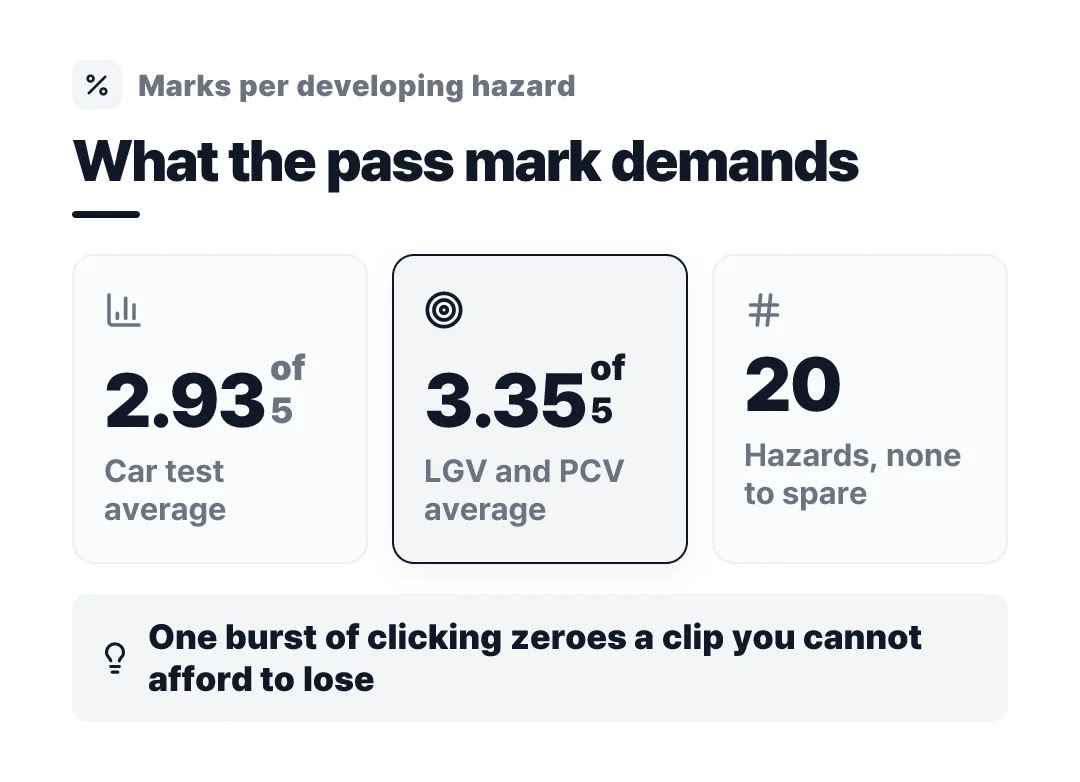
Convert the hazard perception marks into an average per clip and the difference sharpens. On the car test, 44 marks spread across 15 developing hazards is an average of 2.93 out of 5. On the LGV and PCV test, 67 across 20 hazards is an average of 3.35 out of 5. You need to spot each hazard roughly half a second earlier, twenty times running, with no clip to spare.
The multiple-choice side is the opposite story: the percentage bar is fractionally lower than the car test, but there are twice as many questions and you have 15 wrong answers to spend across the whole paper.
Booking, fees and the two-year clock
Part 1a costs £26 and part 1b costs £11, so the theory stage comes to £37 before any training. Those are DVSA's published fees and they do not change for evening or weekend slots, unlike the on-road part 3b test at £115 on a weekday and £141 otherwise.
The timing rule catches people out more often than the fees. Your theory test certificate is valid for two years from the date you passed the first part, not the second. Sit part 1a in January and part 1b in November, and you have burned ten months of a two-year window in which parts 3a and 3b also have to be completed. If the window closes, part 1 is resat in full.
If you fail either part, you can rebook immediately but you cannot sit again for three clear working days. Fail on a Monday afternoon and Friday morning is the earliest slot.
What changed with Driver CPC in 2024 and 2025
Two reforms landed either side of the new year and both are now fully in force — DVSA withdrew its guidance page on the changes in July 2025 on the grounds that they had been introduced.
The first, from 3 December 2024, split the qualification in two. National Driver CPC covers professional driving within the UK only; International Driver CPC covers the EU and beyond. The distinction is decided by the training you take: include any National course in your 35 hours and you end up with a National Driver CPC, and you cannot drive professionally in Europe on it.
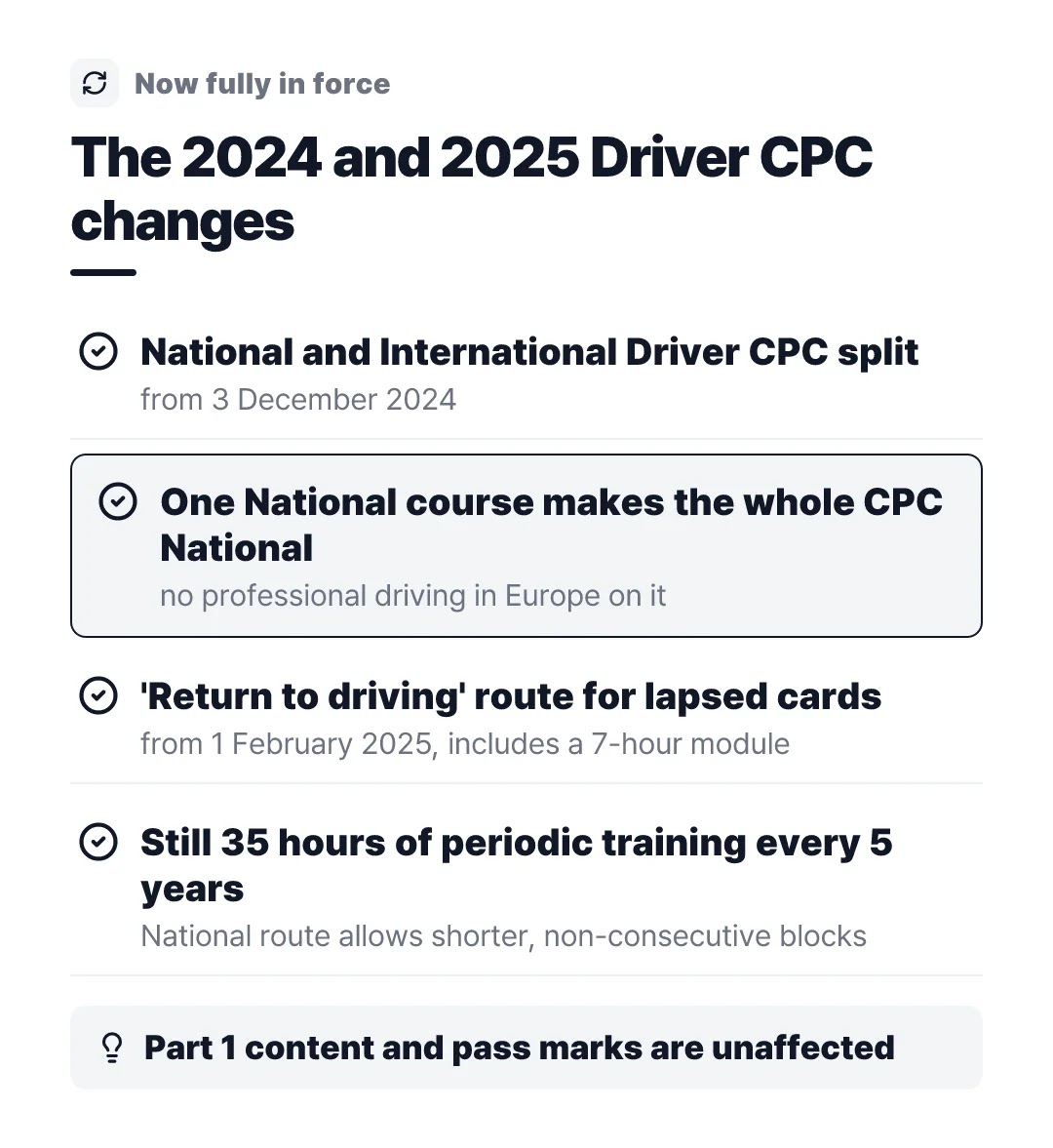
The second, from 1 February 2025, created a route back for drivers whose CPC has lapsed, including a 7-hour 'return to driving' module. Periodic training itself is unchanged in volume — 35 hours every five years — but the National route allows shorter blocks and drops the requirement for multi-day courses to run on consecutive days.
None of this alters part 1. The theory syllabus and both pass marks are as they were. What it does change is which training you book afterwards, and that decision is worth making before you start rather than after.
Where the marks actually go
The multiple-choice bank is not general road knowledge with a lorry on the cover. The material that separates candidates sits in areas a car driver has never had to think about: drivers' hours and tachograph rules, vehicle weights and dimensions, and load security.
Weights are the reliable trap because the test turns on which of four figures a rule refers to. Unladen weight, mass in running order, maximum authorised mass and gross train weight are four different numbers, and signed weight limits bite on the plated MAM regardless of what the vehicle is carrying that day. An empty lorry plated at 26 tonnes is still barred by a 7.5T sign.
Drivers' hours reward a different tactic, because there are two regimes and questions often hinge on which one applies. The assimilated rules — the post-Brexit name for the retained EU regime — and the GB domestic rules set different caps, and mixing both in one week brings its own conditions. Learn the two side by side rather than sequentially; the exam tests the boundary, not the middle of either.
For hazard perception, the constraint is mechanical. Score with single deliberate clicks as the scene develops, because a burst of clicking on one clip zeroes it, and at an average of 3.35 marks per hazard you cannot absorb a zero.
What's in the 53 pages
These are revision notes, leaning on the sections that carry the most questions rather than covering the syllabus evenly. They assume you are consolidating rather than meeting the material for the first time, and they do not include practice questions — DVSA publishes a free practice test on GOV.UK for that.
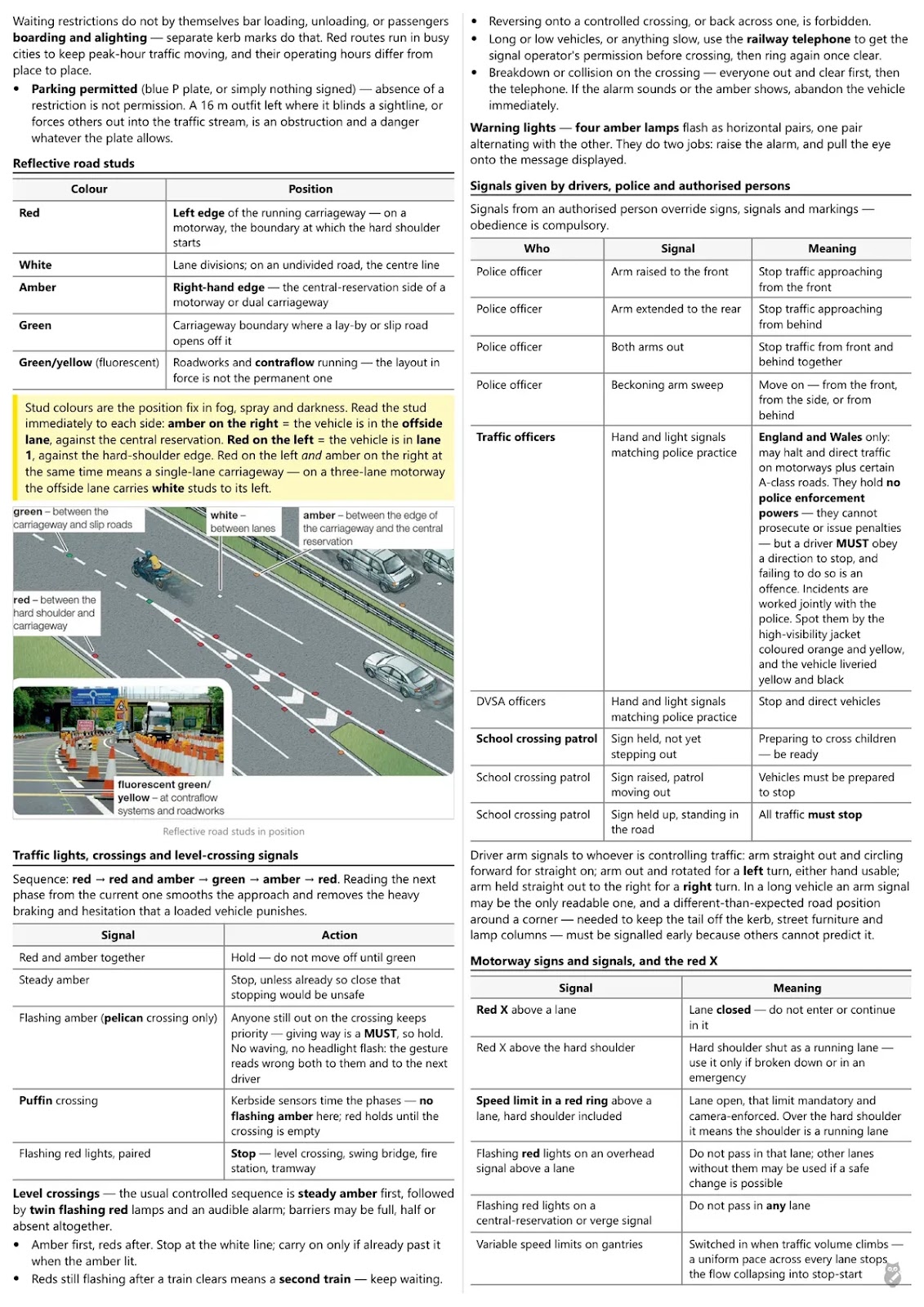
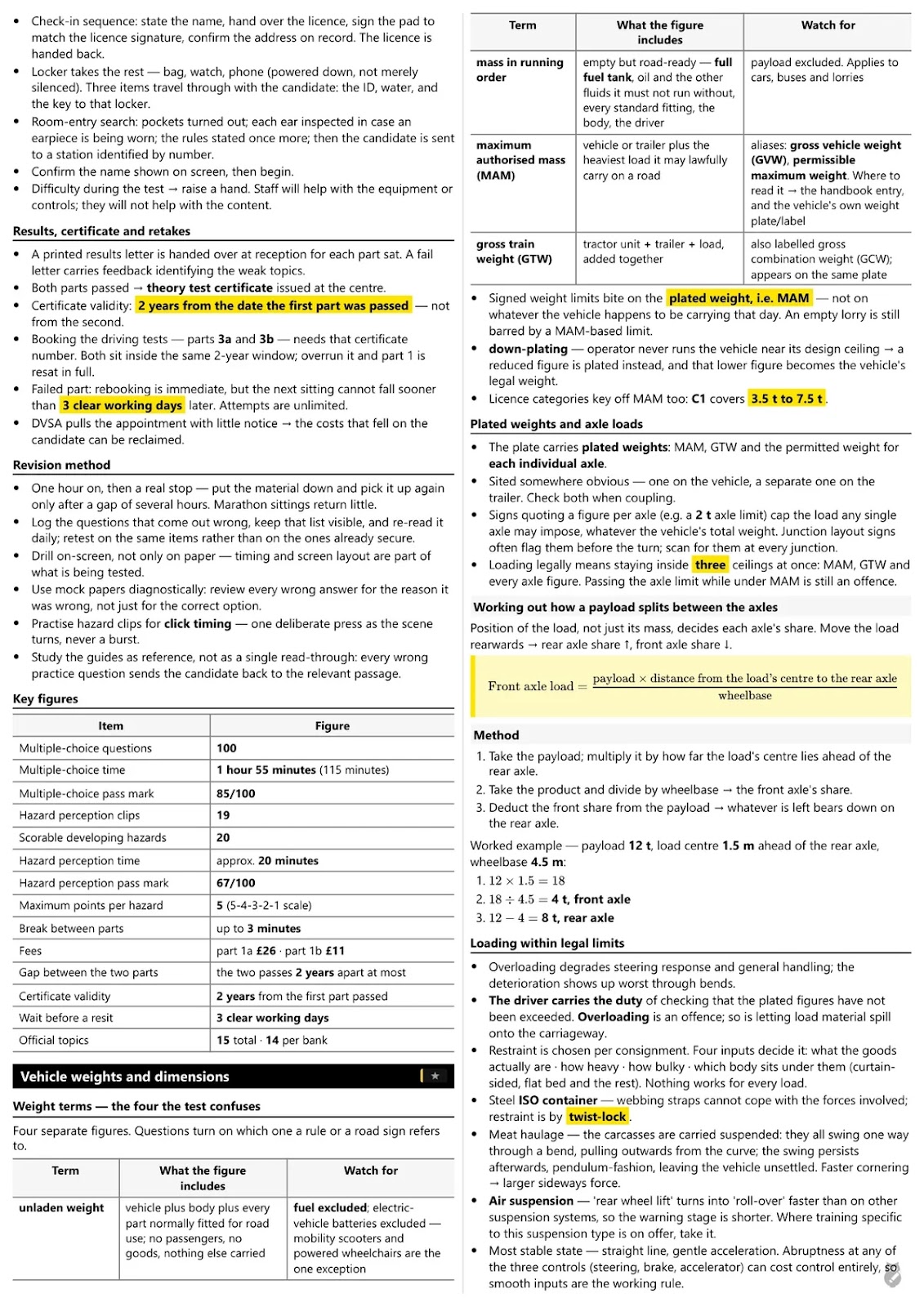
The public preview shows the approach. Drivers' hours are set out as a side-by-side of the assimilated rules against both GB domestic schemes, with the five conditions that apply when a week mixes the two. Weights are handled as the four-term comparison plus a worked axle-load calculation. Signs are grouped by what they do to a large vehicle specifically, including the narrow-road pair that reverses meaning between the red ring and the blue rectangle. The test-day sections cover the check-in sequence, the results letter and the resit rules.
👉 DVSA LGV and PCV theory test revision notes — PDF (53 pages)
https://www.swotnote.com/library/dvsa-lgv-pcv-theory-test-study-guide


FAQ
What is the pass mark for the LGV theory test?
There are two. Part 1a, the multiple-choice paper, requires 85 out of 100. Part 1b, hazard perception, requires 67 out of 100 across 20 scorable developing hazards. Both must be passed, and they are booked and sat as separate tests.
How long does the LGV theory test certificate last?
Two years from the date you passed the first part, not the second. Parts 3a and 3b, the driving tests, must be completed inside that window, otherwise you resit part 1 in full.
Does the 2025 Driver CPC change affect the theory test?
No. The National and International split, introduced on 3 December 2024, and the 'return to driving' route from 1 February 2025 both concern periodic training and requalification. Part 1 content and pass marks are unaffected — but the split determines which periodic training you should book once qualified.
The short version
Part 1 is two tests, two bookings and two pass marks: 85 out of 100 on multiple choice and 67 out of 100 on hazard perception. The hazard perception bar is the one that has moved relative to the car test, demanding an average of 3.35 marks out of 5 on every developing hazard. The two-year certificate clock starts at your first pass, not your last.
Book both parts for the same day if the centre allows it — it protects the two-year window and removes the temptation to leave hazard perception until you feel ready.
📄 Driver CPC part 1: the heaviest-tested sections, condensed
https://www.swotnote.com/library/dvsa-lgv-pcv-theory-test-study-guide
Swotnote is an independent publisher. These are unofficial revision notes and are not affiliated with, endorsed by or produced in association with DVSA or the Department for Transport. Test figures were correct at the time of writing; check GOV.UK for the current position before booking. See our terms and privacy policy.