If your CeMAP 1 sitting is a few weeks away, the useful question is not what the whole syllabus contains but which parts of FRE1 and FRE2 still catch people out, and which numbers have changed since your study text was printed. This guide answers both against the current Walbrook Institute London (LIBF) FSRE specification, version 7, effective July 2026. It also sets out where CeMAP 1 sits on the route to becoming a mortgage adviser, because that decides how much of it you need to carry into your first job.
What CeMAP 1 examines now: two units, not one paper
CeMAP changed for new enrolments from 30 September 2025. The qualification is now five units inside three modules: Financial Services, Regulation and Ethics (FSRE) as module 1, split into FRE1 and FRE2; Mortgages as module 2, split into MRT1 and MRT2; and a case-study assessment of mortgage advice knowledge as module 3. FSRE replaced the old UK Financial Regulation module, and it is the same module used in the Diploma for Financial Advisers, so a pass counts towards both.
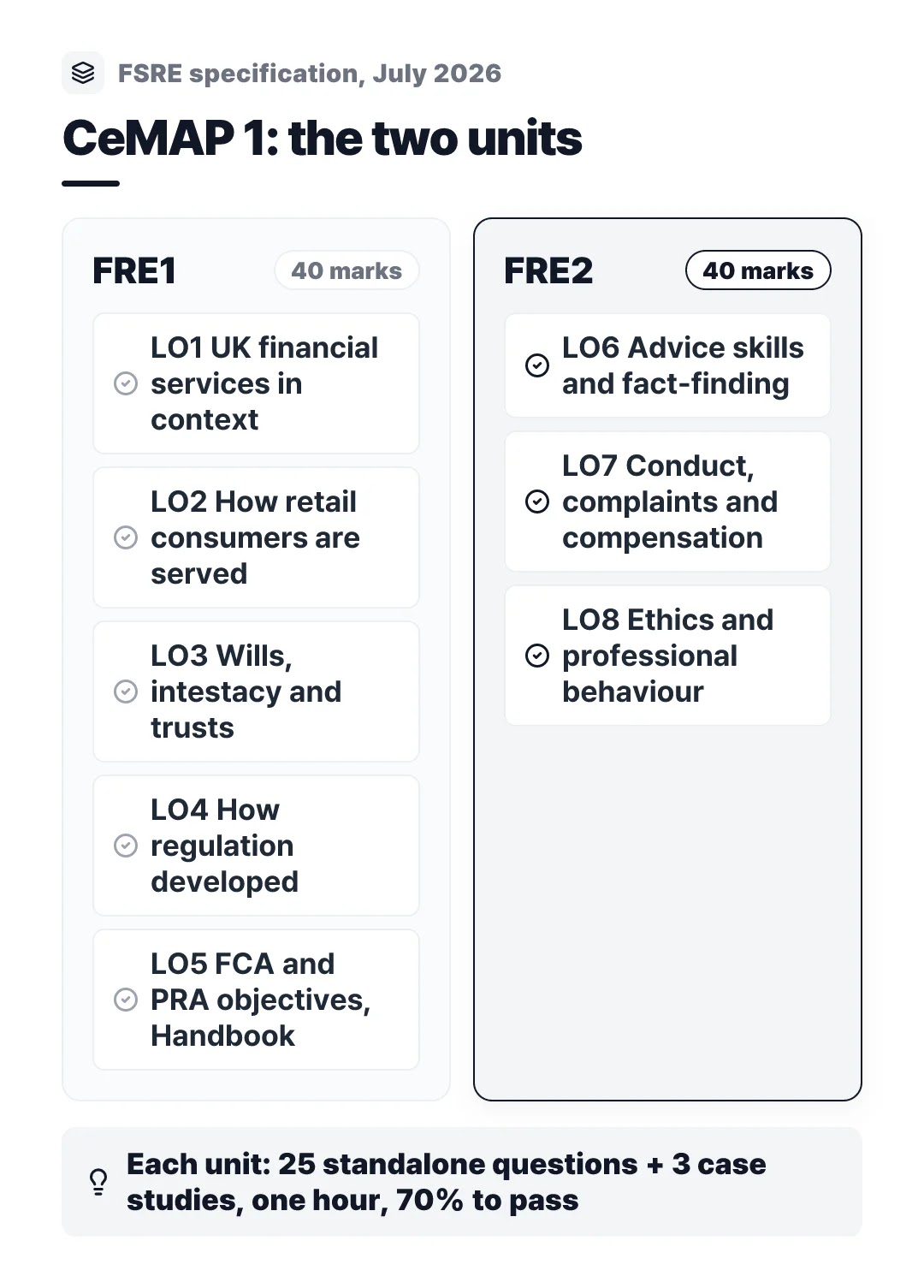
FSRE is a Level 4 award on Ofqual's Regulated Qualifications Framework. FRE1 covers Industry, Regulation and Key Parties; FRE2 covers Skills, Principles and Ethical Behaviours. Each unit is a one-hour online exam, sat through Brightspace with remote invigilation, and each is worth 40 marks. The first 25 marks come from standalone multiple-choice questions; the remaining 15 come from three short case studies with five linked questions apiece.
The CeMAP 1 pass mark is 70 per cent in each unit, which means 28 out of 40. You cannot bank a strong FRE1 score against a weak FRE2, because each unit is passed separately. Walbrook lists FSRE registration, including the first attempt at each unit, at £330 at the time of writing, with resits at £120 per unit. Some training sites still quote an older £310, so check the figure on the booking page before you pay.
The figures that have moved since your textbook was printed
Most CeMAP 1 marks are lost on wording rather than on numbers, but the numbers are where an older study text quietly lets you down. The FSRE specification lists topics, not figures, and it does not name a legislation cut-off date, so the safe approach is to learn the current figure and recognise the old one when it appears as a distractor.
| Figure | Before | Now | Effective |
|---|---|---|---|
| FSCS deposit protection, per person per banking licence | £85,000 | £120,000 | 1 December 2025 |
| FSCS joint account | £170,000 | £240,000 | 1 December 2025 |
| FSCS temporary high balance (six months) | £1 million | £1.4 million | 1 December 2025 |
| Financial Ombudsman award limit, acts on or after 1 April 2019 | £445,000 | £455,000 | 1 April 2026 |
| Financial Ombudsman award limit, acts before 1 April 2019 | £200,000 | £205,000 | 1 April 2026 |
| Normal minimum pension age | 55 | 57 | 6 April 2028 |
Every row above is a figure printed in the Swotnote CeMAP 1 notes, where it sits next to the rule it belongs to. Each one was then checked against the FSCS, the Financial Ombudsman Service and the Bank of England's announcement of the PRA decision, with the pension age checked against pension-provider technical guidance.
Two of these rows are traps rather than facts to memorise. FSCS deposit cover follows the banking licence, not the brand, so two brands under one licence share a single £120,000 limit. The pension age rise to 57 is legislated for April 2028, so a question set in 2026 can still correctly treat 55 as the current minimum.

Where the 40 marks go, and the order to revise them
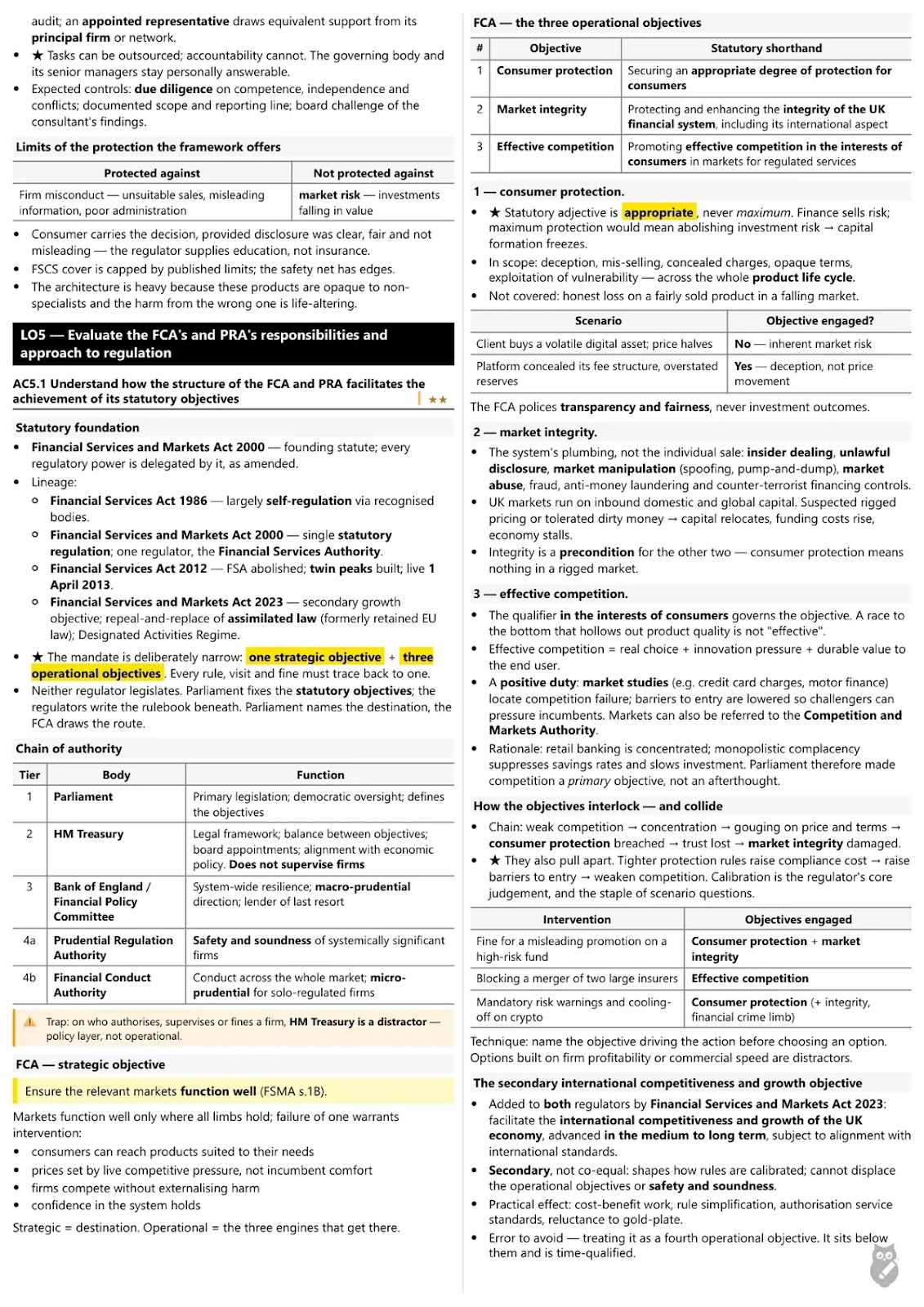
The 25 standalone questions reward exact recall. One candidate who sat the new FSRE in autumn 2025 described the second paper as "more about precision and less about understanding", and that matches how FRE2 is built: complaint deadlines, client categories, disclosure and adviser charging rules, where the right answer and the distractor differ by a single word. Learn the FCA's operational objectives in their statutory wording. The consumer protection objective is securing an appropriate degree of protection, never the maximum, and questions test that adjective directly.
The 15 case-study marks are more forgiving than they look. The same candidate found the case studies "short and very doable", with most linked questions answerable without rereading the whole scenario. Read the question first, then go back to the scenario only for the fact it needs. That habit saves the minutes you will want for the standalone questions on regulation.
For FRE1, start with learning outcome 5, the FCA and PRA's statutory objectives and the FCA Handbook, because it underpins questions across both units. Then work through learning outcome 3 on wills, intestacy, trusts and powers of attorney, which is heavy on definitions and rewards a single focused session. Learning outcome 1 on the wider economy and the Bank of England can come last. It is broad, but the questions tend to test who does what: HM Treasury sets policy and does not supervise firms, which makes it a frequent distractor in questions about authorisation and enforcement.
For FRE2, put learning outcome 7 first. Complaint handling, the Financial Ombudsman Service, the FSCS, anti-money-laundering duties and data protection all sit there, and they are where the moved figures in the table above live. Learning outcome 8 on ethics is best revised by practising the difference between ethical and compliance-driven behaviour, since the specification asks you to distinguish the two rather than define them.
Where CeMAP 1 fits on the route to mortgage adviser
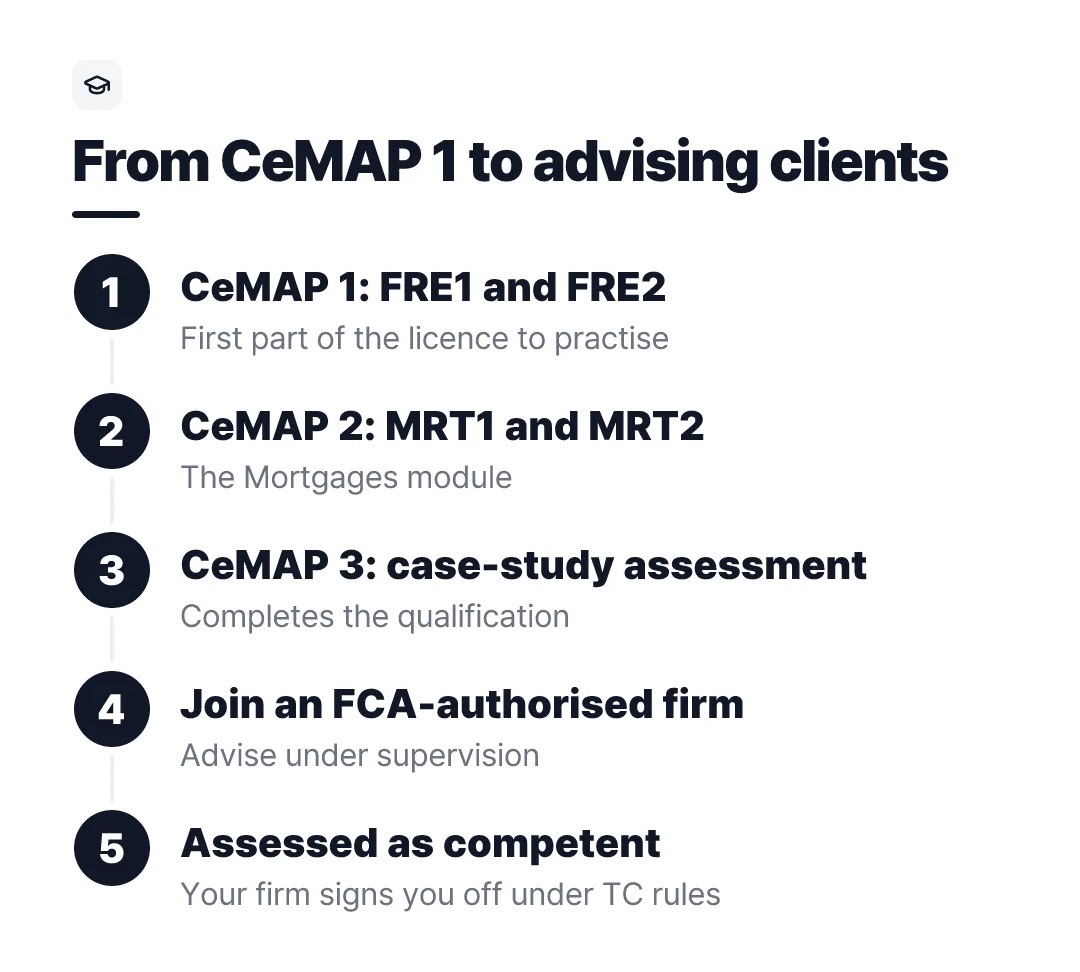
The FSRE specification describes the module as the first part of the licence to practise qualification for mortgage advisers. Passing it on its own does not let you advise. You still need the Mortgages module (MRT1 and MRT2) and the module 3 case-study assessment to hold the full CeMAP, which Walbrook states meets the FCA's examination standards for mortgage advice.
The qualification is only half of what the FCA requires. Under the Training and Competence sourcebook, a firm must not let an employee advise on regulated mortgage contracts without appropriate supervision until it has assessed that person as competent. In practice that means joining an FCA-authorised broker, bank or network as a trainee and advising under supervision until the firm signs you off. Firms set their own criteria for that point, which is why the length of the supervised period varies from employer to employer.
There are three common ways in. Some people self-fund CeMAP and apply as newly qualified trainees; some join a broker academy that recruits trainees and supports them through the exams; and CeMAP is a mandated qualification in the Mortgage Adviser apprenticeship standard, which suits those already employed by a lender or broker. Whichever route you take, CeMAP 1 comes first, so this is the module worth getting right on the first attempt.
What the 66 pages cover
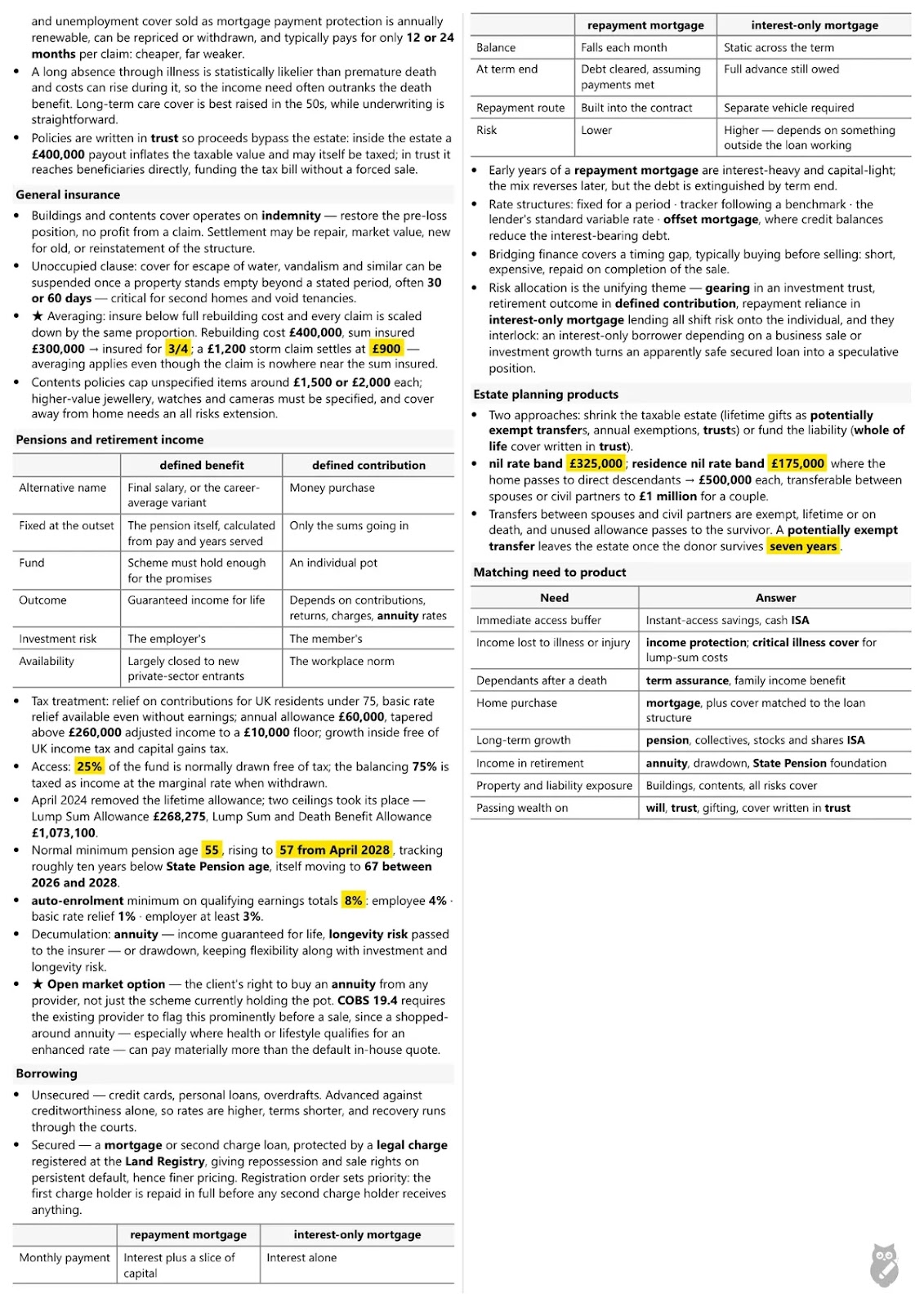
The Swotnote CeMAP 1 revision notes run to 66 pages and are organised by the FSRE learning outcomes and assessment criteria, so each section maps to a line of the specification. Assessment criteria carry a star rating for exam priority, which in the final week shows you which sections deserve a second read and which can be skimmed. Figures are highlighted where they appear, and common distractors are flagged in callout boxes, including the HM Treasury trap above.
The notes are weighted toward tested topics, with the most space given to the FCA Handbook, ethics and the advice rules. They are not a complete replacement for the LIBF study text, and some lower-priority material is covered briefly or not at all. They are revision notes rather than a question bank, so they do not include past papers or mock exams.


👉 CeMAP 1 (FSRE) revision notes — PDF (66 pages)
https://www.swotnote.com/library/cemap-1-last-minute-revision
FAQ
Is CeMAP 1 the same as FSRE?
Yes, for anyone who enrolled from 30 September 2025. FSRE, Financial Services, Regulation and Ethics, is the current CeMAP module 1 and is examined as two units, FRE1 and FRE2. Older materials that refer to UKFR describe the module it replaced.
What is the CeMAP 1 pass mark?
It is 70 per cent in each unit, so 28 out of 40 in FRE1 and 28 out of 40 in FRE2. The two units are passed separately, so a high score in one does not make up for the other.
How long do I have to complete CeMAP?
Walbrook allows 12 months per module if you register module by module, or 18 months for the full qualification when all three modules are registered together. Most people take CeMAP 1 first, because the other modules assume the regulatory grounding it provides.
The short version
CeMAP 1 is now two one-hour units at 70 per cent each, examined against the July 2026 FSRE specification. Revise FCA objectives and FRE2's complaints and compensation rules first, and check every figure in your notes against the table above.
📄 66 pages against the July 2026 FSRE specification
https://www.swotnote.com/library/cemap-1-last-minute-revision
Swotnote is an independent publisher. These are unofficial revision notes and are not affiliated with, endorsed by or produced in association with Walbrook Institute London, LIBF or the Financial Conduct Authority. They are not financial or mortgage advice. Fees, exam formats and regulatory figures change; check the current position with Walbrook before you book.